Table of Contents
QA auditing hot air tools is the most critical step for North American B2B distributors seeking to protect their supply chain and brand reputation. Proactive procurement requires more than just negotiating favorable prices; it demands rigorous quality assurance. When sourcing directly from overseas manufacturers, relying solely on a polished spec sheet is a massive risk. To confidently supply the civil engineering and plastic fabrication sectors, you must dig deeper into the engineering reality. Here is the definitive checklist for evaluating your manufacturing partner.
When sourcing directly from overseas manufacturers, relying solely on a polished spec sheet is a massive risk. To confidently supply the civil engineering and plastic fabrication sectors, you must dig deeper into the engineering reality. Here is the definitive checklist for QA auditing hot air tools to ensure your manufacturing partner delivers genuine industrial performance.
1. Verify the “True Output” on Standard Grids
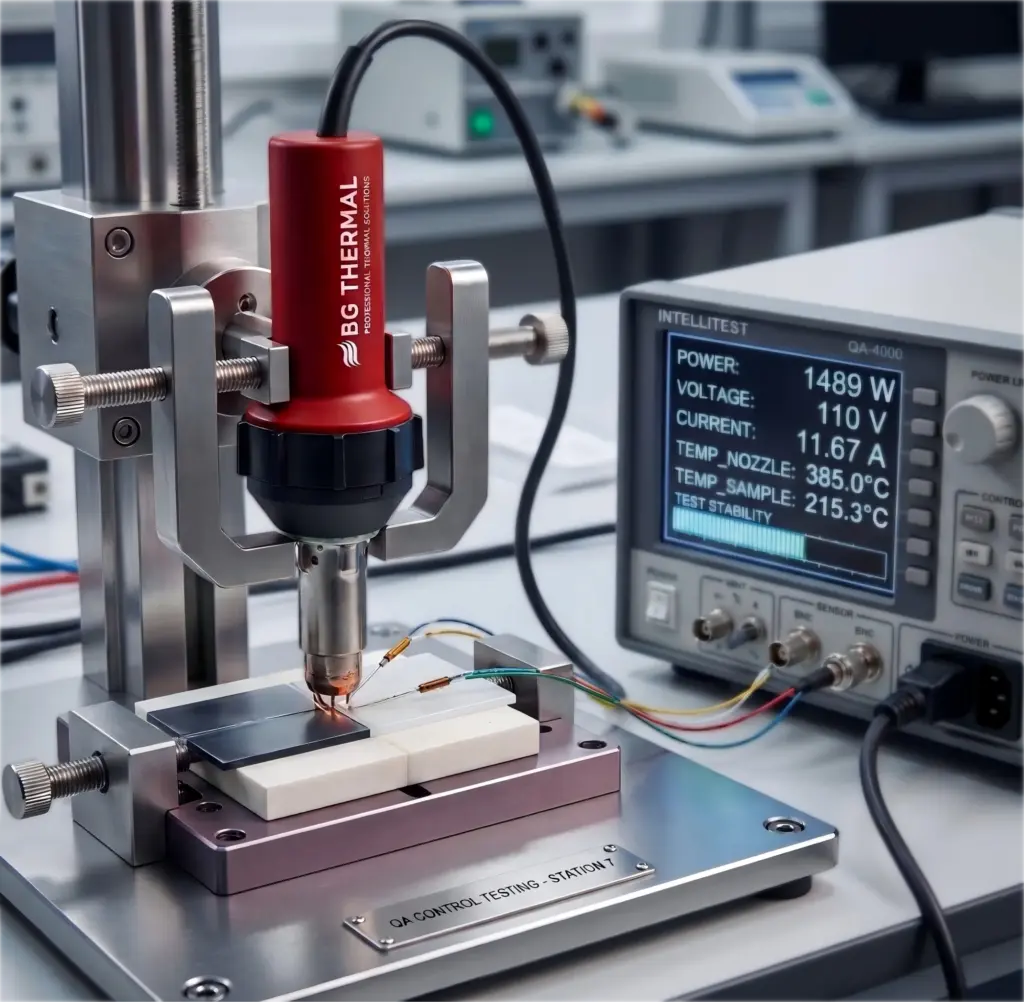
The most common deception in the thermal equipment market is wattage inflation. Many standard tools claim a 2000W output, which is physically dangerous and highly unstable on a standard North American 110V-120V/15A commercial circuit. When QA auditing hot air tools, demand physical testing documentation. A transparent factory will prove that their heavy-duty straight-barrel welders run on a True Verified Output of 1600W (or 1400W-1500W for standard handhelds). This ensures the tool will not trip site breakers or suffer voltage drops when running continuously on portable generators in harsh environments.
2. Inspect the Motor Architecture and Lifespan
Standard consumer heat guns often hide cheap motors with a maximum lifespan of 300 to 500 hours. In a commercial fabrication setting, this equates to a tool burning out in just a few weeks. During your evaluation process, require a breakdown of the internal motor components. A critical step in QA auditing hot air tools is verifying the presence of a pure copper motor. Ask the supplier to confirm the carbon brush rating. True industrial equipment should explicitly guarantee a carbon brush motor lifespan of 800 to 1,000 hours of intermittent operation, drastically lowering the Total Cost of Ownership (TCO) for your end-users.
3. Demystify Safety Certifications (The Power Cord Rule)
Electrical safety compliance is a major pain point for North American distributors. Unfortunately, ambiguous certification claims run rampant among unverified suppliers. A rigorous process for QA auditing hot air tools must clarify exactly what is certified. For instance, if a supplier claims broad compliance, dig into the paperwork. An honest, professional manufacturer will clearly state that while they do not hold a whole-unit ETL certification, their heavy-duty power cords are strictly UL-listed. This specific certification on the cable is the most critical safety feature, preventing electrical resistance fires on abusive, high-traffic job sites.
4. Check for Replaceable Components
Industrial tools are an investment. If a heating element burns out or a mica core cracks, the entire unit should not end up in a landfill. Evaluate the factory’s replacement part ecosystem. Are replacement mica core heating elements, carbon brushes, and speed welding nozzles readily available and easy for a technician to swap out?
5. Request Unedited Testing Documentation
A final, often overlooked step in the auditing process is requesting raw, unedited testing footage or factory QA reports. A legitimate factory will gladly provide video evidence of their tools running continuously for hours under full load. If a supplier hesitates to share actual factory floor QA data, consider it a major red flag.
Conclusion: Partner with a Transparent Source
Executing a strict protocol for QA auditing hot air tools separates reliable sourcing investments from costly inventory mistakes. By demanding true 1600W output data, verifying 800-1000 hour pure copper motors, and clarifying specific UL power cord certifications, distributors can build a bulletproof product catalog.
Don’t settle for opaque trading companies. Contact BG Thermal today to partner with a transparent Shenzhen manufacturer that welcomes your most rigorous QA audits.